

“Freedom is a heavy load, a great and strange burden for the spirit to undertake. It is not easy. It is not a gift given, but a choice made, and the choice may be a hard one. The road goes upward towards the light; but the laden traveler may never reach the end of it.”
My wife and I were discussing books, as we are wont to do. I was being critical of a pop spirituality book that I had recently read (I don’t recall which) and she asked me: “What’s the most spiritually beneficial book you’ve read lately?”
I didn’t hesitate. The Tombs of Atuan by Ursula K. Le Guin (the source of the quote above). It’s often classified as a piece of young adult literature, but I missed out on reading it in my teens and early twenties, so here I am reading the books in Le Guin’s Earthsea cycle for the first time. And for the first time in a long time, a book made me wipe away tears from my eyes as Tenar makes the difficult choice to be free of the old and hungry gods she once served; and again as she arrives in Havnor to the friendly hands of its people, eager to welcome her out of the darkness and into the light.
So often the books recommended to me are pop spirituality: cloying at best, and often vapid. “Of making many books there is no end,” as Solomon ponders in Ecclesiastes 12:12. How true that is in our day, when there is a perpetual parade of publication, much of which advertises itself as a new perspective or heretofore unknown insight. Truly, there is nothing new under the sun.
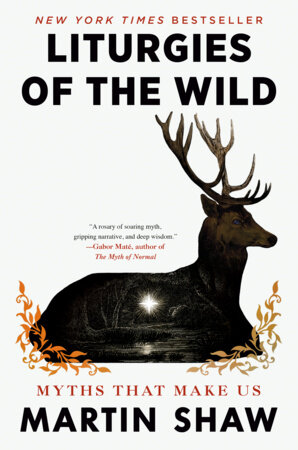
Martin Shaw is very much aware of that as he adds his Liturgies of the Wild to the never-ending stream of the many books being made. He does not think that he is providing something new; rather, he is pursuing a very, very old way of finding (and at times making) meaning out of life. From the beginning, story has been the mode for the transmission of truth. You can imagine Adam sitting down with his sons and daughters: “In the beginning God created . . .” Before Moses put stylus to tablet, multiple millennia passed in which the only way any truth reached new ears was through the spoken word—the gospel included. Shaw’s footsteps further pack in the well-walked ruts in the road of human storytelling.
Yet his journey to Christian faith was one that we confessional Lutherans may balk at. While he grew up in a Christian household—the son of a preacher, in fact—he wandered into hedonism, debauchery, and paganism. He spent years as a wilderness and rite-of-passage guide; which is still his primary vocation, it seems. During a fast and vigil in the wilderness, he had a private experience in which the vision of a light came from heaven and told him to “Inhabit the Time and Genesis of Your Original Home” (pg. 14). From there, he reexamined his history in the Church and explored Eastern Orthodoxy, where he has now found his home as a Christian.
From Shaw’s experience and his home in Orthodoxy we can see why he approaches faith through the lens of myth and story and is less interested in systematic theology and personal adherence to confession. Yet, if you read between the lines, you will find in his stories some humming heartstrings that resonate in harmony with your own.
But you may grow frustrated. Shaw defies you learning any lessons from him. Not because he has none to teach; but as a story teller, he is not pedantic. He does not lead you along by the nose to point you to every truffle he’d hoped you’d find in the soil of these stories he weaves into his book.
This can be seen as a refreshing change of pace for those frustrated by the vapid or cloying messages of pop spirituality. If you’re looking for a book that has a solid thesis that you can present in an elevator pitch, you’ll be hard-pressed to find it here. The closest Shaw comes to such a thesis is the framework of Severance-Threshold-Return as a progression of initiation. For those familiar with Joseph Campbell’s monomyth, this framework will be familiar as a compacted version of the Hero’s Journey. Shaw invites his readers to see their own lives through the lens of Severance-Threshold-Return and to allow the stories he tells to shape the way they tell their own.
At the core of humanity, in Shaw’s view, is the project of telling stories. Cultural myths, scriptural truths, and family heritage are passed along to us by story. But as valuable and important as story is to the creation of a human being,1 “the more unexamined, the more corrosive, even dangerous [stories] can become” (pg. 9). So Shaw examines stories; his own, the stories of the Church, of culture. He challenges and prods at what makes us comfortable. He explores a number of topics: initiation, guilt, prayer, evil. The book is meandering (appropriate for a wilderness guide) and largely stream-of-consciousness.
At times, you may grow frustrated that he doesn’t adequately explain himself or cite his sources. This is not an academic book, nor an exercise in theological discussion. It’s more personal, less structured. And for my soul, it was a breath of cool morning air. It’s not a long read; 230 pages won’t take you very long at all. Read it twice and let the thoughts marinate. You might find some familiar shapes among the trees along the path this wilderness guide takes you on.
Which brings me back to the quote with which I opened this review. Freedom is a heavy load. Being human, being Christian, is not an easy task. The gospel—not an abstract body of knowledge about Christ, but the story of Christ’s love for his people and his creation—shows us the path upward towards the light: the Savior who is the Way, the Truth, and the Life. While you will find much to criticize about Martin Shaw’s approach to the gospel, he recognizes the heavy load that God’s people must carry as sinner-saints (even if he wouldn’t use that same language), and he has set out to lighten those burdens with the gifts that he has been given.
And the gifts that he has been given are the gifts of stories, and the ability to tell them. “Without steadfastness we would never have the discipline for the night vigil, without restlessness we would never have the adventure that God desires for us. To be humbly in touch with both is more a transmission of truth than any apologetics we can muster,” (pg. 77). A good story can be of greater spiritual benefit than most of the endless books that are being made to teach us good theology. Even storytellers outside our own tradition may provide us with a new perspective on truth that refreshes us, as Le Guin did for me. You may disagree with the doctrine of a storyteller like Shaw, but do not too quickly dismiss his words.